
Cubic Feet to Cubic Yards Converter and Chart
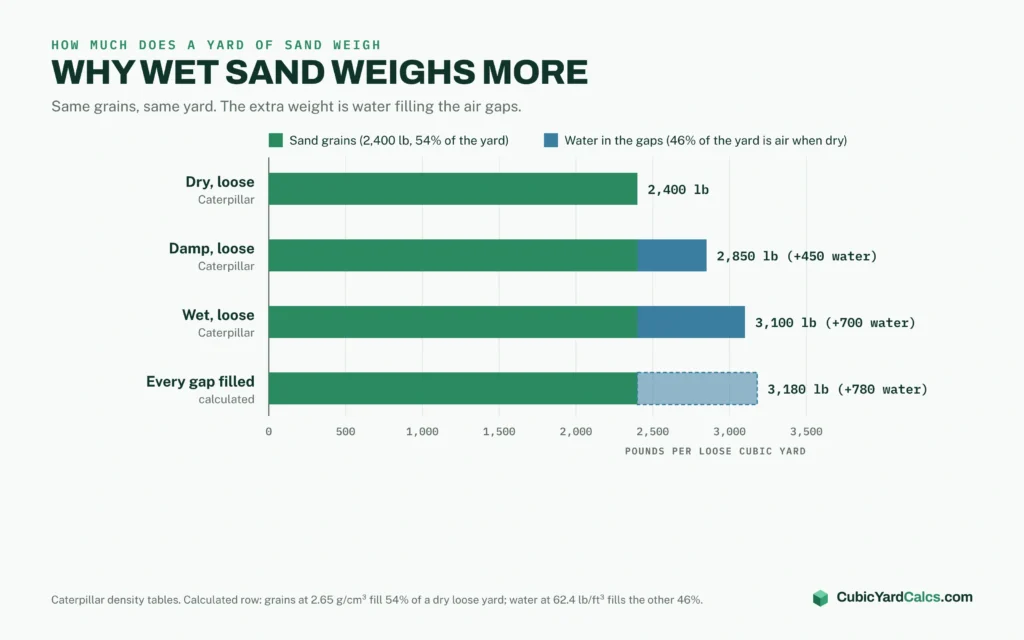
A cubic yard of dry, loose sand weighs about 2,400 pounds (1.2 tons). The same yard wet weighs about 3,100 pounds (1.55 tons). Those are the Caterpillar density table figures, and the 700-pound gap between them is water, not sand.
- POUNDS
- 0
- WATER VS DRY
- 0
- YARDS PER TON
- 0
So how much does a yard of sand weigh for your order? Plan on 1.2 tons if it is dry and 1.55 tons if it has been rained on, and use the estimator to run your own yards:
A Yard of Dry Sand Weighs About 1.2 Tons
Caterpillar lists sand in three moisture states, each loose (dug and dumped, the way it arrives) and in bank (undisturbed in the ground). A yard of sand always means a cubic yard, so these figures also answer how much a cubic yard of sand weigh. A state agency figure sits in the same range:
|
Sand |
Loose |
Bank (in place) |
Source |
|---|---|---|---|
|
Sand, dry |
2,400 (1.2 t) |
2,700 (1.35 t) |
Caterpillar |
|
Topsoil |
2,050 |
3,200 (1.6 t) |
Caterpillar |
|
Sand, wet |
3,100 (1.55 t) |
3,500 (1.75 t) |
Caterpillar |
|
Sand and gravel, dry |
2,900 (1.45 t) |
3,250 (1.63 t) |
Caterpillar |
|
Sand and gravel, wet |
3,400 (1.7 t) |
3,750 (1.88 t) |
Caterpillar |
|
Sand |
2,900 (1.45 t) |
not stated |
New Mexico MMD |
A delivered load is loose, so the loose column answers how much a yard of sand weigh on the truck. The New Mexico Mining and Minerals Division uses 1.45 tons per cubic yard to convert reported sand production, about halfway between dry and wet loose sand.
Sold names such as play sand, mason sand, and concrete sand are mostly about grain size and cleanliness. None of the public tables above breaks them out, so ask the supplier which weight their ton-to-yard conversion uses.
Sand and Gravel Mixes Weigh More
Gravel mixed in changes how much a yard of sand weigh, because sand fills the gaps between stones and the mix packs tighter than either alone. Dry and loose, it weighs 2,900 pounds per yard against 2,400 for dry sand. For gravel on its own, see how much a yard of gravel weighs.
Water Can Add 700 Pounds to a Yard of Sand
Sand stockpiles sit outside. After rain, how much does a yard of sand weigh can change by the next delivery, with no change in the volume you ordered. Damp sand is 450 pounds heavier per loose yard than dry, and wet sand 700 pounds heavier. In gallons, that is about 54 and 84 gallons of water riding along in every yard, at 8.34 pounds per gallon.
That changes a delivery in three ways: a truck legal for a set weight carries fewer yards of wet sand, a sale by the ton buys fewer yards when the sand is wet, and a trailer or wheelbarrow that handled dry sand can be overloaded by the same volume wet.
The Arithmetic Behind Wet Sand
You can check the wet figure yourself with two published numbers. Most soil and sand grains have a particle density of about 2.65 g/cm³, nearly the density of quartz (University of Wyoming soil manual/05%3A_Soil_Physics_and_Water_Relations/5.04%3A_Particle_Density). Water weighs about 62.4 pounds per cubic foot (USGS).
- Solid grains: 2.65 g/cm³ is about 4,467 pounds per cubic yard if a yard were solid quartz with no gaps.
- Dry loose sand: 2,400 ÷ 4,467 = 0.54, so grains fill 54 percent of the yard and air fills the other 46 percent.
- Water to fill the gaps: a full cubic yard of water weighs 62.4 × 27 = 1,685 pounds, so 46 percent of it is about 780 pounds.
- Saturated loose sand: 2,400 + 780 = about 3,180 pounds, close to Caterpillar’s 3,100 for wet loose sand.
The same steps for bank sand (2,700 pounds, 40 percent air) give about 3,370 pounds saturated, against 3,500 in the table. Real sand rarely fills every gap with water, so treat the saturated number as the ceiling for how much a yard of sand weigh when wet.
A Ton of Sand Is About Three Quarters of a Yard
Turn how much does a yard of sand weigh into yards per ton by dividing:
cubic yards per ton = 2,000 ÷ pounds per cubic yard
For loose sand that is 0.83 cubic yards per ton dry, 0.70 damp and 0.65 wet. So how many yards in a ton of sand? Roughly two-thirds to five-sixths of a yard, depending on the weather. Ten tons of dry loose sand is about 8.3 yards; ten tons of wet sand, about 6.5.
A Cubic Foot of Sand Weighs About 89 to 115 Pounds
How much does a cubic foot of sand weigh? Divide the yard figure by 27: about 89 pounds dry, 106 damp and 115 wet for loose sand. A 50 pound bag of dry sand is about 0.56 cubic feet, and 5 cubic feet of loose sand weighs about 444 to 574 pounds.
Half a Yard Fits a Small Trailer, If the Weight Allows
A half load is a common way to haul sand yourself. Before you load, find the trailer’s Gross Vehicle Weight Rating: federal rules require it on the certification label on the forward half of the trailer’s left side (49 CFR 567.4). Subtract the empty trailer weight to get what it can carry. The label sets the limit; how much does a yard of sand weigh on the day sets how much of the trailer you can fill.
Suppose the label says 2,990 pounds GVWR and the empty trailer weighs 640 pounds (example numbers, so read yours). That leaves 2,350 pounds for sand:
- Half a yard, dry: 1,200 pounds. Fits, with room to spare.
- Half a yard, wet: 1,550 pounds. Still fits.
- A full yard, wet: 3,100 pounds. About 750 pounds over.
Your tow vehicle’s towing and tongue weight limits apply as well. Our dirt weight guide shows the same check for a pickup bed.
Three Checks Before the Sand Arrives
- Ask whether the stockpile is dry or has been rained on, because that decides how much does a yard of sand weigh on delivery day: about 2,400 or 3,100 pounds.
- If you buy by the ton, convert to yards with the cubic yards to tons converter so you know what you are getting.
- If you are not sure how many yards you need, size the job first with the cubic yard calculator.
Common Sand Weight Questions
About 2,400 pounds for dry, loose sand and about 3,100 pounds for wet, loose sand. Sand still packed in the ground runs 2,700 to 3,500 pounds. That is how much does a yard of sand weigh in pounds; divide by 2,000 for tons.
About 0.56 cubic feet of dry, loose sand at 89 pounds per cubic foot, or 0.5 cubic feet of packed dry sand at 100 pounds. Damp bagged sand takes up less space for the same weight.
Five US gallons is 0.67 cubic feet, so a full bucket of dry, loose sand weighs about 59 pounds, and wet sand about 77 pounds.