
How Much Does a Yard of Concrete Weigh? (Concrete Weight Calculator)
A cubic yard of normal weight concrete weighs about 3,915 pounds, just under 2 tons. That uses the 145 pounds per cubic foot the Federal Highway Administration calls typical. The mix, the steel inside it and the type of stone move the figure from roughly 3,780 to 4,185 pounds.
- POUNDS
- 0
- CUBIC YARDS
- 0
- PER SQ FT
- 0
Short answer: plan on a concrete weight per yard of about 4,000 pounds (2 tons), which is 145 to 150 pounds per cubic foot.
For a slab, the calculator below works out how much does a yard of concrete weigh across your whole pour, from length, width and thickness:
Use 145 to 150 Pounds per Cubic Foot for Normal Concrete
Engineers call it the unit weight of concrete: the weight of concrete per cubic foot. Multiply it by 27 and you have how much does a yard of concrete weigh, which is the same question as how much does a cubic yard of concrete weigh. The published ranges:
- Normal weight, typical: 145 lb per cubic foot, or 3,915 lb per cubic yard (FHWA).
- Normal weight, full range: 140 to 155 lb per cubic foot, or 3,780 to 4,185 lb per cubic yard (FHWA).
- Reinforced, for dead load: 150 lb per cubic foot, or 4,050 lb per cubic yard. Minnesota DOT uses this figure for the dead load of reinforced concrete bridge elements.
- Code boundary: the ACI 318-14 building code treats concrete at 135 lb per cubic foot or more as normal-weight (summary by StructurePoint), which is 3,645 lb per cubic yard.
Concrete and cement are not the same thing. Cement is one ingredient; stone and sand make up most of a yard’s weight, which is why the type of aggregate matters more than the brand of cement.
Add About 135 Pounds per Yard for Rebar
Steel changes how much does a yard of concrete weigh, though less than most people expect. The FHWA takes reinforced concrete as 5 lb per cubic foot heavier than plain concrete, and notes heavily reinforced members can run up to 10 lb heavier. Times 27, that is about 135 pounds per yard for ordinary rebar and up to 270 pounds for dense steel. Wire mesh in a patio slab adds far less.
Expect Lightweight Concrete to Weigh 14 to 24 Percent Less
Lightweight concrete uses expanded shale, clay or slate in place of ordinary stone. The FHWA puts it at 110 to 125 lb per cubic foot, so how much does a yard of concrete weigh in lightweight form comes to about 2,970 to 3,375 pounds, roughly 14 to 24 percent lighter than the 145 lb typical mix.
Separate the Fresh Yard From the Cured Yard
The yard that leaves the plant and the yard that sits in your slab weigh almost the same. Concrete loses some water as it dries, but for many mixes the FHWA describes the gap between fresh and dried (equilibrium) density as small, on the order of 5 lb per cubic foot or less. That is no more than about 135 pounds per yard, so for planning, how much does a yard of concrete weigh fresh is also what it weighs cured.
Where the difference does matter is the truck. A ready mix truck carries fresh concrete at around 4,000 pounds a yard, so every yard on the ticket is two tons the truck, the driveway and any curb it crosses have to bear.
Expect Lightweight Concrete to Weigh 14 to 24 Percent Less
Broken concrete is the exception to how much does a yard of concrete weigh. Once a slab is broken up, a cubic yard of rubble is full of air gaps, so it weighs much less than a solid yard. The EPA memo on volume to weight factors uses 860 pounds per cubic yard for concrete in construction and demolition debris, with or without rebar. That is a waste tracking factor rather than a hauling limit, as our dirt weight guide explains for soil. For a dumpster, ask the hauler for the weight limit and weigh the solid slab first: it is the same concrete either way.
Work Out the Weight of a 10 by 10 Slab at 4 Inches
Here is the arithmetic behind how much does a yard of concrete weigh once it becomes a real slab. Take a 10 by 10 foot patio poured 4 inches thick:
- Area: 10 × 10 = 100 square feet.
- Volume: 100 × (4 ÷ 12) = 33.3 cubic feet, which is 33.3 ÷ 27 = 1.23 cubic yards.
- Weight, plain: 33.3 × 145 = about 4,833 pounds (2.4 tons).
- Weight, reinforced: 33.3 × 150 = 5,000 pounds (2.5 tons).
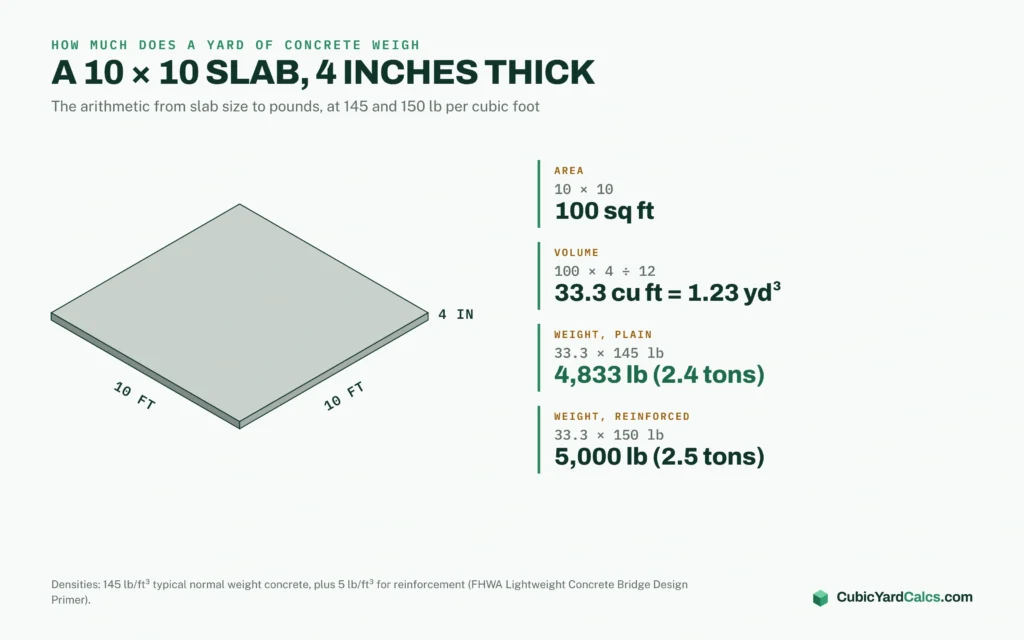
Per square foot, that slab weighs about 48 pounds plain or 50 pounds reinforced. Every extra inch of thickness adds about 12 pounds per square foot at 145 lb per cubic foot.
Check Slab Weights for Common Sizes
The same steps show how much does a yard of concrete weigh adds up across bigger pours, using 145 lb per cubic foot for plain concrete and 150 for reinforced:
|
Slab |
Cubic yards at 4 in |
4 in, plain (145) |
4 in, reinforced (150) |
6 in, plain (145) |
|---|---|---|---|---|
|
10 × 10 ft |
1.23 |
4,833 lb |
5,000 lb |
7,250 lb |
|
10 × 12 ft |
1.48 |
5,800 lb |
6,000 lb |
8,700 lb |
|
12 × 12 ft |
1.78 |
6,960 lb |
7,200 lb |
10,440 lb |
|
10 × 20 ft |
2.47 |
9,667 lb |
10,000 lb |
14,500 lb |
|
12 × 24 ft |
3.56 |
13,920 lb |
14,400 lb |
20,880 lb |
|
20 × 20 ft |
4.94 |
19,333 lb |
20,000 lb |
29,000 lb |
|
24 × 24 ft |
7.11 |
27,840 lb |
28,800 lb |
41,760 lb |
A 24-by-24-foot garage slab at 4 inches is about 7.1 cubic yards and close to 14 tons of concrete. At 6 inches, it passes 20 tons.
Turn the Weight Into Tons for Hauling or Disposal
Once you know how much does a yard of concrete weigh for your mix, divide pounds by 2,000 for US tons, or run the yards through the cubic yards to tons converter, which carries the same concrete range. If you still need the yards for a pour, start with the cubic yard calculator.
More Concrete Weight Questions
About 145 pounds for typical normal weight concrete, 150 pounds with rebar, and 110 to 125 pounds for lightweight concrete.
About 39,150 pounds (19.6 tons) at 145 lb per cubic foot, or 40,500 pounds (20.3 tons) at 150 lb.
A US gallon is 0.134 cubic feet, so a gallon of normal weight concrete weighs about 19 to 20 pounds.
Five gallons is 0.67 cubic feet, so a full bucket of normal weight concrete weighs about 97 to 100 pounds.