
Cubic Feet to Cubic Yards Converter and Chart
Twenty-seven cubic feet make one cubic yard. To change cubic feet to cubic yards, divide by 27; to go back, multiply cubic yards by 27. The converter below works in both directions, and the 1 to 100 chart covers everyday amounts at a glance.
- CUBIC YARDS
- 0
- ORDER IN HALF YARDS
- 0
- BAGS NEEDED
- 0
How to Convert Cubic Feet to Cubic Yards
The conversion is a single step because both units measure the same thing, volume, just at different sizes. Divide the number of cubic feet by 27, and the answer is in cubic yards.
The Cubic Feet to Cubic Yards Formula
cubic yards = cubic feet ÷ 27
If you would rather multiply, 1 cubic foot equals 0.037037 cubic yards, which is 1 ÷ 27 rounded to six places. Dividing by 27 gives the same result with no rounding, so it is the simpler way to convert cubic feet to cubic yards by hand or on a phone.
Why You Divide by 27
How many cubic feet in a cubic yard is a question of shape. A yard is 3 feet, so a cube one yard on every side measures 3 × 3 × 3 feet, which is 27 cubic feet. The number is exact, not rounded. The United States has defined the yard as exactly 0.9144 meters since 1959, as NIST Handbook 44 sets out, and volume units are built from those length units.
Example: Converting 40 Cubic Feet
A raised bed that holds 40 cubic feet of soil works out like this:
40 ÷ 27 = 1.48 cubic yards
That is just under one and a half yards. Type any other amount into the converter, and it runs the same cubic feet-to-cubic-yards division for you, along with cubic inches, a half-yard order size, and a bag count.
Common Mistake: Dividing by 3 or 9 Instead of 27
Because a yard is 3 feet, the instinct is to divide by 3. Here is what each divisor does to a 54 cubic foot pile:
- 54 ÷ 3 = 18: That treats a volume like a length and orders nine times too much.
- 54 ÷ 9 = 6: Nine is the number of square feet in a square yard, so this is still three times too high.
- 54 ÷ 27 = 2: Two cubic yards, the right answer.
The small number on the unit tells you the divisor. Feet to yards is 3, square feet to square yards is 9, and cubic feet to cubic yards is 27, which is 3 multiplied by itself three times. Labels and invoices often shorten the step to cu ft to cu yd, and the divisor stays 27.
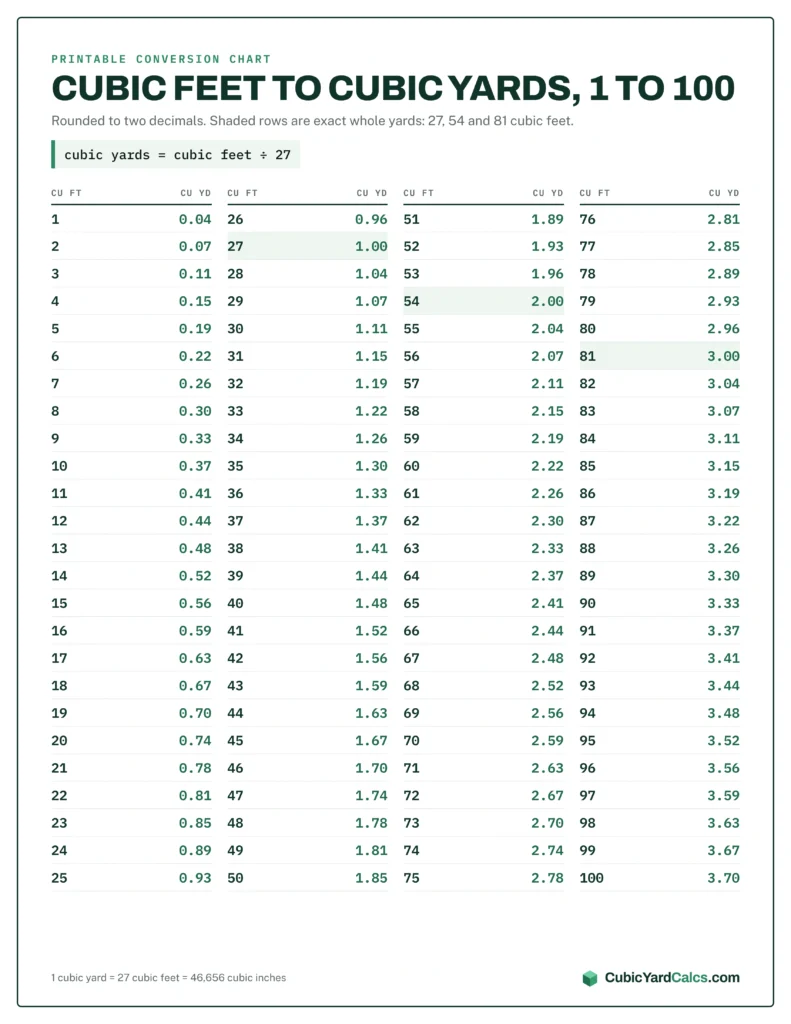
Cubic Feet to Cubic Yards Conversion Chart (1 to 100)
This cubic feet to cubic yards chart lists every whole number from 1 to 100, rounded to two decimal places. Two decimals are already finer than a loader bucket can deliver, so there is no need for more. The rows for 27, 54, and 81 land exactly on 1, 2, and 3 yards, which makes them handy anchors when you are estimating cubic feet and cubic yards in your head.
Printable Chart
| Cu ft | Cu yd | Cu ft | Cu yd | Cu ft | Cu yd | Cu ft | Cu yd |
|---|---|---|---|---|---|---|---|
| 1 | 0.04 | 26 | 0.96 | 51 | 1.89 | 76 | 2.81 |
| 2 | 0.07 | 27 | 1.00 | 52 | 1.93 | 77 | 2.85 |
| 3 | 0.11 | 28 | 1.04 | 53 | 1.96 | 78 | 2.89 |
| 4 | 0.15 | 29 | 1.07 | 54 | 2.00 | 79 | 2.93 |
| 5 | 0.19 | 30 | 1.11 | 55 | 2.04 | 80 | 2.96 |
| 6 | 0.22 | 31 | 1.15 | 56 | 2.07 | 81 | 3.00 |
| 7 | 0.26 | 32 | 1.19 | 57 | 2.11 | 82 | 3.04 |
| 8 | 0.30 | 33 | 1.22 | 58 | 2.15 | 83 | 3.07 |
| 9 | 0.33 | 34 | 1.26 | 59 | 2.19 | 84 | 3.11 |
| 10 | 0.37 | 35 | 1.30 | 60 | 2.22 | 85 | 3.15 |
| 11 | 0.41 | 36 | 1.33 | 61 | 2.26 | 86 | 3.19 |
| 12 | 0.44 | 37 | 1.37 | 62 | 2.30 | 87 | 3.22 |
| 13 | 0.48 | 38 | 1.41 | 63 | 2.33 | 88 | 3.26 |
| 14 | 0.52 | 39 | 1.44 | 64 | 2.37 | 89 | 3.30 |
| 15 | 0.56 | 40 | 1.48 | 65 | 2.41 | 90 | 3.33 |
| 16 | 0.59 | 41 | 1.52 | 66 | 2.44 | 91 | 3.37 |
| 17 | 0.63 | 42 | 1.56 | 67 | 2.48 | 92 | 3.41 |
| 18 | 0.67 | 43 | 1.59 | 68 | 2.52 | 93 | 3.44 |
| 19 | 0.70 | 44 | 1.63 | 69 | 2.56 | 94 | 3.48 |
| 20 | 0.74 | 45 | 1.67 | 70 | 2.59 | 95 | 3.52 |
| 21 | 0.78 | 46 | 1.70 | 71 | 2.63 | 96 | 3.56 |
| 22 | 0.81 | 47 | 1.74 | 72 | 2.67 | 97 | 3.59 |
| 23 | 0.85 | 48 | 1.78 | 73 | 2.70 | 98 | 3.63 |
| 24 | 0.89 | 49 | 1.81 | 74 | 2.74 | 99 | 3.67 |
| 25 | 0.93 | 50 | 1.85 | 75 | 2.78 | 100 | 3.70 |
How to Convert Cubic Yards to Cubic Feet
The reverse of cubic feet to cubic yards is a multiplication: multiply cubic yards by 27. For example, three yards of topsoil is 3 × 27 = 81 cubic feet.
cubic feet = cubic yards × 27
Cubic Yards to Cubic Feet Table
Common order sizes from half a yard to 20 yards, with cubic inches alongside for anyone working from small container specs.
| Cubic Yards | Cubic Feet | Cubic Inches |
|---|---|---|
| 0.5 | 13.5 | 23,328 |
| 1 | 27 | 46,656 |
| 1.5 | 40.5 | 69,984 |
| 2 | 54 | 93,312 |
| 2.5 | 67.5 | 116,640 |
| 3 | 81 | 139,968 |
| 4 | 108 | 186,624 |
| 5 | 135 | 233,280 |
| 6 | 162 | 279,936 |
| 8 | 216 | 373,248 |
| 10 | 270 | 466,560 |
| 12 | 324 | 559,872 |
| 15 | 405 | 699,840 |
| 20 | 540 | 933,120 |
Cubic Inches to Cubic Feet and Cubic Yards
A cubic foot is 12 × 12 × 12 inches, or 1,728 cubic inches. A cubic yard is 36 × 36 × 36 inches, or 46,656 cubic inches. For cubic inches to cubic yards, divide by 46,656; for cubic feet, divide by 1,728. A planter box measuring 24 by 18 by 16 inches holds 6,912 cubic inches, which is exactly 4 cubic feet, or 0.15 of a cubic yard. From cubic feet, the step to cubic yards is the usual division by 27, exactly as in the cubic feet to cubic yards chart above.
Liquid volume is the other common crossover, and the number of gallons in a cubic yard is worked through on its own page.
What Does “a Yard” Mean When You Order Soil, Mulch or Gravel?
At a landscape or aggregate supplier, a yard of mulch, topsoil, or gravel means a cubic yard. Nobody sells soil by the running yard, so a quote for 3 yards of topsoil is a quote for 81 cubic feet, and anyone asking how many cubic feet are in a yard of dirt gets the same 27. The cubic feet to cubic yards math is identical for every bulk material.
What changes between materials is the price per yard, and weight is behind most of that gap. Using the sourced ranges in our calculator, a yard of wood chips weighs roughly 0.12 to 0.24 tons while a yard of 3/4 inch gravel weighs roughly 1.28 to 1.69 tons. Weight decides how much fits on one truck, which is why converting yards to tons matters once you start comparing stone quotes.
How Many Bags Make a Cubic Yard?
Bagged soil, mulch, and stone are labeled in cubic feet, while bulk delivery is quoted in cubic yards, so comparing them means running the numbers back from yards to feet. Multiply the yards by 27, divide by the bag size printed on the front, and round up, because no store sells part of a bag.
Bags Per Cubic Yard By Bag Size
| Bag size | ½ cubic yard | 1 cubic yard | 2 cubic yards | 3 cubic yards |
|---|---|---|---|---|
| 0.5 cu ft | 27 | 54 | 108 | 162 |
| 0.75 cu ft | 18 | 36 | 72 | 108 |
| 1 cu ft | 14 | 27 | 54 | 81 |
| 1.5 cu ft | 9 | 18 | 36 | 54 |
| 2 cu ft | 7 | 14 | 27 | 41 |
| 3 cu ft | 5 | 9 | 18 | 27 |
Rounding Cubic Yards for a Supplier Order
A converter gives decimals; a supplier loads in steps. Many sell in whole or half cubic yards, so once you change cubic feet to cubic yards, round up: 40 cubic feet (1.48 yards) becomes a 1.5-yard order, and 60 cubic feet (2.22 yards) becomes 2.5. Ask the yard what step they load in and whether there is a minimum order before you settle on the number.
If all you have so far is length, width, and depth, work out the volume from your measurements first, then come back here for the bag math.
Cubic Feet to Cubic Yards FAQs
100 ÷ 27 = 3.70 cubic yards. Rounded up to the next half yard for an order, that is 4 yards.
No. Three cubic feet is one ninth of a cubic yard, about 0.11. A cubic yard holds 27 cubic feet, because the yard is 3 feet in each of three directions.
Twenty-seven. When a supplier sells a yard of soil, dirt, or mulch, it means a cubic yard, and the cubic feet in it are the same regardless of the material.
One cubic foot is about 0.037 of a cubic yard (1 ÷ 27). It takes 27 of them to fill a yard, so going from cubic feet to cubic yards always means dividing by 27.
Keep the printable chart and the bag table handy, and the cubic feet-to-cubic yards math is done before you call the supplier.