
How Much Does a Yard of Dirt Weigh? (Topsoil, Fill and Wet vs Dry)
How much does a yard of dirt weigh? About 1,600 to 3,400 pounds (0.8 to 1.7 tons), and the caveat matters as much as the range: published figures for “a yard of dirt” disagree by more than half a ton, because they measure soil in different states. Dry and loose sits at the light end. Packed or soaked sits at the heavy end.
- POUNDS
- 0
- YARDS PER TON
- 0
- PER CUBIC FOOT
- 0
This guide shows the figures side by side, explains why the answer to how much does a yard of dirt weigh changes from source to source, and gives you a number to plan with. The estimator below does the multiplication for any soil and any number of yards.
- Dry, loose topsoil: about 1,600 to 2,100 pounds per cubic yard.
- Packed, moist or clay-heavy dirt: about 2,500 to 2,800 pounds.
- Soaked topsoil: about 3,375 pounds, close to 1.7 tons.
- One ton of dry, loose topsoil is roughly 1 to 1.25 cubic yards.
- For hauling, plan with the wet figure. For ordering, ask which figure the supplier uses.
How Much Does a Cubic Yard of Dirt Weigh by Soil Type?
Two public references give figures for both loose soil (dug and dumped, the way it arrives) and packed or in-place soil: the Caterpillar earthwork density tables and a material weight chart compiled from EPA and NTEA data. Suppliers use soil and dirt for the same product, so these figures also answer how much does a yard of soil weigh:
|
Soil |
Loose (as delivered) |
Packed or in place |
Source |
|---|---|---|---|
|
Topsoil |
1,600 |
2,300 |
Caterpillar |
|
Topsoil |
2,050 |
2,565 (packed) |
EPA and NTEA chart |
|
Loam |
2,100 |
2,600 |
Caterpillar |
|
Clay, dry |
2,500 |
3,100 |
Caterpillar |
|
4,000 |
1.56 |
1.48 |
1.19 |
|
Earth, dry packed |
2,550 |
3,200 |
Caterpillar |
|
Earth, wet excavated |
2,700 |
3,400 |
Caterpillar |
|
Clay, wet |
2,800 |
3,500 |
Caterpillar |
|
Topsoil, wet |
3,375 |
not listed |
EPA and NTEA chart |
So how much does a yard of dirt weigh once it is delivered? Read the loose column for anything delivered or hauled. The packed column describes soil still in the ground or compacted in place, which is why it runs 500 to 700 pounds heavier for the same type.
How Much Does a Yard of Topsoil Weigh?
Dry and loose, a yard of topsoil weighs about 1,600 pounds on the Caterpillar table and 2,050 pounds on the EPA and NTEA chart, so roughly 0.8 to 1 ton. Packed topsoil reaches 2,300 to 2,565 pounds, and a soaked yard about 3,375 pounds. If you need one planning figure for how much does a yard of dirt weigh when that dirt is topsoil, 2,000 pounds (1 ton) is a fair middle for dry delivered material.
What About Fill Dirt?
Fill dirt is subsoil with little organic matter, and no single figure covers it, because fill can be sandy, loamy or clay-heavy, so how much does a yard of dirt weigh for fill depends on the pit it came from. The New Mexico Mining and Minerals Division uses 0.8 tons per cubic yard for both fill dirt and topsoil in its conversion factors. For excavated fill, the Caterpillar figures for dry packed earth (2,550 pounds loose) and dry clay (2,500 pounds loose) are a safer planning number, since fill is rarely as light as screened topsoil.
What Changes the Weight of a Yard of Dirt?
Three things move how much does a yard of dirt weigh more than anything else:
- Moisture. Water is the biggest swing. On the EPA and NTEA chart, a yard of loose topsoil goes from 2,050 pounds dry to 3,375 pounds wet, about 65 percent heavier. A pile left uncovered before a storm is a different load the next morning.
- Clay. Clay-heavy soil weighs more than loam in the Caterpillar table: 2,500 pounds loose when dry against 2,100 for loam, and 2,800 when wet. Clay also holds water longer than sandy soil, so it stays heavy after rain.
- Screening and stones. Screened topsoil has had stones, roots and clods removed. Stone is far heavier than soil (2 to 6 inch rock is about 3,200 pounds per yard on the EPA and NTEA chart), so a rocky, unscreened load from the same site can weigh more than the screened product.
Packing works the other way round on volume. Caterpillar gives topsoil a load factor of 0.70, meaning one cubic yard dug from the ground becomes about 1.43 loose yards once excavated. Earth that was dry and packed has a load factor of 0.80, so a bank yard becomes about 1.25 loose yards.
Why Do Published Dirt Weights Disagree?
Search for how much does a yard of dirt weigh and you will find answers from under 1,000 pounds to over 3,000. Most of that spread comes from sources measuring different things. Compared side by side:
|
Source |
Figure |
What it actually measures |
|---|---|---|
|
US EPA volume to weight memo |
929 lb (dirt and sand) |
A construction and demolition debris factor for comparing recycling rates between areas. Not a soil weight for ordering. |
|
New Mexico Mining and Minerals Division |
1,600 lb (0.8 tons), topsoil and fill |
A factor for converting reported mine production from yards to tons. Does not say loose or in place. |
|
Caterpillar density tables |
1,600 lb loose, 2,300 lb bank (topsoil) |
Earthmoving figures for loose and in-place soil, with a footnote that moisture, grain size and compaction change them. |
|
USDA NRCS soil bulk density |
About 1,850 to 2,700 lb (1.10 to 1.60 g/cm³) |
Dry soil in the ground with all water removed. These are the upper limits of the ideal range for roots, from clayey (1.10) to sandy (1.60) soil. |
|
EPA and NTEA material chart |
2,050 lb loose, 2,565 lb packed, 3,375 lb wet (topsoil) |
Hauling weights for loose, packed and wet topsoil. |
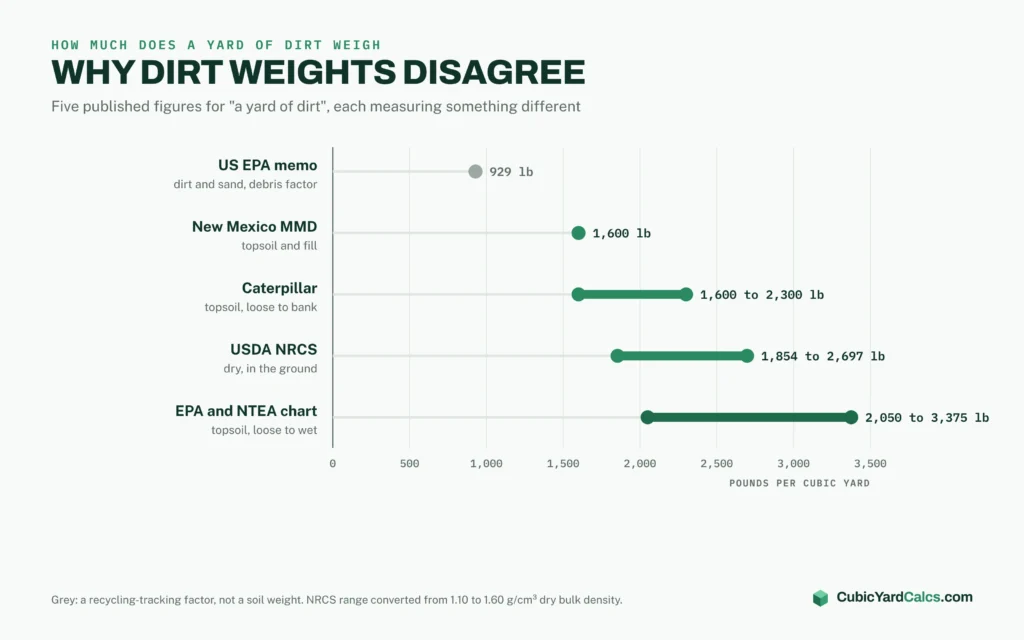
The USDA NRCS bulk density figures convert from grams per cubic centimeter at about 1,686 pounds per cubic yard for each 1.0 g/cm³. The EPA memo figure is the one to ignore for ordering: it was built for waste tracking, and real soil runs two to three times heavier.
How Many Yards of Dirt Are in a Ton?
Once you know how much does a yard of dirt weigh, divide 2,000 pounds by that figure:
cubic yards per ton = 2,000 ÷ pounds per cubic yard
For dry, loose topsoil that gives 1.25 cubic yards per ton at 1,600 pounds and 0.98 at 2,050 pounds. Wet excavated earth (2,700 pounds) drops to 0.74, and soaked topsoil (3,375 pounds) to 0.59. So a ton of dirt is anywhere from a little over half a yard to a yard and a quarter, depending on how wet and loose it is.
How Much Does a Cubic Foot of Dirt Weigh?
To scale how much does a yard of dirt weigh down to a cubic foot, divide by 27. Dry, loose topsoil is about 59 to 76 pounds per cubic foot (1,600 ÷ 27 and 2,050 ÷ 27), wet excavated earth about 100 pounds, and soaked topsoil about 125 pounds.
Can a Pickup Truck Haul a Yard of Dirt?
Often not in one trip, and the bed size will not warn you. The limit is the payload on the placard on the driver’s door pillar, minus everyone in the cab. Our gravel weight guide explains where that number comes from and has a load table by payload.
A quick check for dirt: suppose your placard leaves 1,500 pounds after the driver (an example; read yours). That carries 0.73 cubic yards of dry, loose topsoil at 2,050 pounds per yard, but only 0.44 cubic yards if the same topsoil is soaked at 3,375 pounds. In other words, how much does a yard of dirt weigh on delivery day can decide whether you need two trips or three for the same yard.
Where Do You Go From Here?
Now that you know how much does a yard of dirt weigh for your soil and its condition, run your yards through the cubic yards to tons converter to turn an order or a truck limit into tons. If you still need the yards themselves, start with the cubic yard calculator.
Questions People Ask About Dirt Weight
Between about 1,600 and 3,400 pounds. Dry, loose topsoil is about 1,600 to 2,050 pounds; packed, clay-heavy or wet soil runs 2,500 pounds and up.
Yes, by a lot. On the EPA and NTEA chart a yard of loose topsoil weighs 2,050 pounds dry and 3,375 pounds wet, a difference of 1,325 pounds.
About 10,250 pounds (5.1 tons) for dry, loose topsoil at 2,050 pounds per yard, and up to about 16,875 pounds (8.4 tons) if it is soaked.
Twenty tons is 40,000 pounds. That is about 19.5 cubic yards of dry, loose topsoil at 2,050 pounds per yard, or about 14.8 cubic yards of wet excavated earth at 2,700 pounds.
By weight, about 40 to 51 bags, using 1,600 to 2,050 pounds for a yard of dry, loose topsoil. Bagged soil is often damp, so check the volume printed on the bag as well.
A US gallon is 231 cubic inches, or 0.134 cubic feet, so a gallon of dry, loose topsoil weighs about 8 to 10 pounds, and soaked topsoil about 17 pounds.