
Cubic Yard Calculator: Yards, Tons and Bags in 3 Steps
Bulk material is sold by the cubic yard, and almost nobody measures a garden bed or a driveway that way. You measure in feet and inches, then you have to turn those numbers into something a supply yard understands.
That is the whole job of the cubic yard calculator below. Enter your measurements, choose what you are buying, and you’ll get the volume in cubic yards, a bag count, and a sensible amount to order, including waste.
MEASUREMENTS
EACH CUBE IS ONE CUBIC YARD
- CUBIC FEET
- 0
- WEIGHT RANGE
- pick a material
- BAGS
- 0
- COST
- add a price
Order 0 cubic yards if your supplier works in half yards.
Enter a measurement greater than zero.
WHERE THE WEIGHT RANGE COMES FROM
Weight is a range, not one figure, because the same material weighs differently wet and dry and no two suppliers screen a product the same way. Confirm the exact tons per cubic yard with your supplier before ordering by weight.
| MATERIAL | TONS PER CU YD | SOURCE |
|---|---|---|
| Mulch, wood chips | 0.12 to 0.24 | US EPA Volume-to-Weight Conversion Factors (2016), wood chips dry to green |
| Topsoil | 1.02 to 1.69 | Material weight chart sourced to EPA and NTEA, loose to wet |
| Fill dirt, clay | 1.15 to 1.49 | Same chart, dry to wet |
| Gravel, 3/4 inch | 1.28 to 1.69 | Same chart, dry to wet |
| Crushed stone | 1.35 | Same chart, average |
| Sand | 1.38 to 1.65 | Same chart, dry to wet |
| Concrete, poured | 1.82 to 2.16 | ACI 318-14 clause 2.3, normalweight concrete 135 to 160 lb per cubic foot |
| Asphalt | 1.35 | Material weight chart sourced to EPA and NTEA |
Cross-check: USDA NRCS publishes soil bulk density by texture. Converted to tons per cubic yard that gives about 1.18 for loam and 1.35 for sand, both inside the ranges above.
Quick Answer
To calculate cubic yards, multiply length by width by depth in feet, then divide by 27. If your depth is in inches, multiply the square footage by the depth in inches and divide by 324 instead.
Example: a 20-by-12-foot bed at 3 inches deep needs 2.22 cubic yards, or about 2.5 yards once you allow for settling. The cubic yard calculator on this page runs both steps for you.
Main Points
- One cubic yard holds 27 cubic feet, because a yard is three feet on every side.
- Divide by 27 when your depth is in feet. Divide by 324 when it is in inches.
- Depth changes the order of magnitude far more than small errors in the area measurement do.
- Volume is the same for every material. Weight is not, so ask your supplier for tons per cubic yard of the exact product.
- Add 5 to 10 percent for settling and spillage, then round up to your supplier’s next increment.
How To Calculate Cubic Yards
Three measurements and one division. Knowing the steps means you can check a delivery ticket before the truck leaves your driveway.
- Measure the length and width of the area in feet.
- Convert your depth to feet by dividing the inches by 12.
- Multiply the three numbers together, then divide the result by 27.
That last step is the one people forget. A cubic yard is a cube measuring one yard on every side, and because NIST defines the yard as exactly three feet, the cube holds 3 by 3 by 3, or 27 cubic feet.
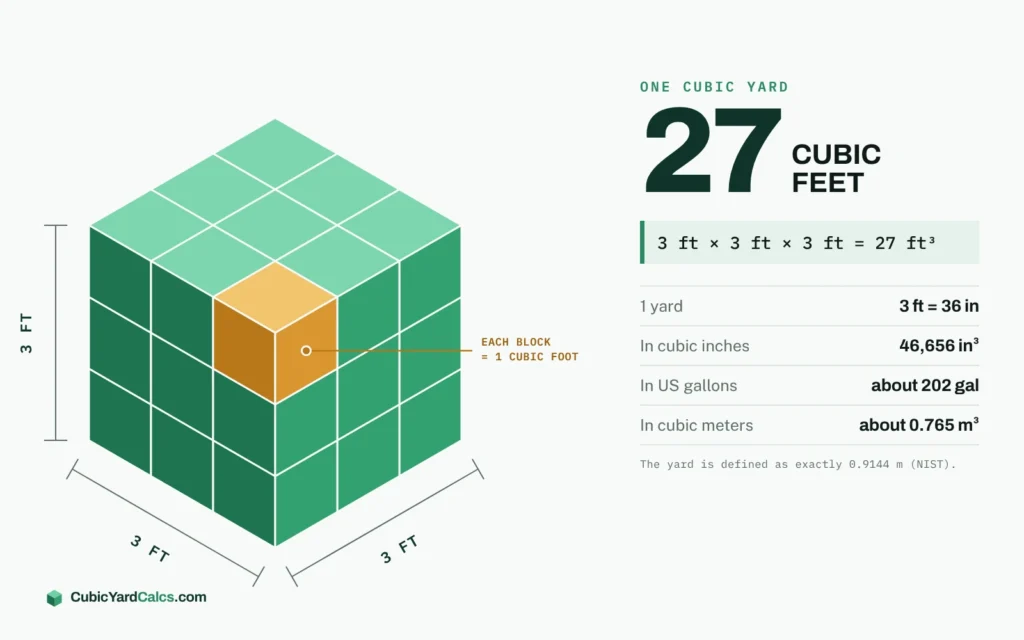
The Cubic Yard Formula
cubic yards = (length in feet × width in feet × depth in feet) ÷ 27
Convert the depth to feet before you multiply. Mixing units here is the single most common reason a first attempt lands about twelve times too high.
The Shortcut Most Crews Use
If your depth is already in inches, skip the conversion. Multiply the square footage by the depth in inches, then divide by 324. The 324 is 27 cubic feet multiplied by 12 inches, so it handles both steps at once.
cubic yards = (square feet × depth in inches) ÷ 324
Both routes give the same answer. The second is faster when you are standing in the yard with a tape measure in one hand and a phone in the other.
Measuring Shapes That Are Not Rectangles
Very few real spaces are neat rectangles, and they do not need to be.
- Circles: measure across the widest point for the diameter, halve it for the radius, then multiply the radius by itself and by 3.14.
- Triangles: multiply the base by the height and divide by two.
- Odd shapes: split the space into rectangles and circles, work each one out, and add them. The tool above has an add another area button that totals them for you.
Curved beds are easier than they look. Treat a kidney-shaped bed as two or three overlapping rectangles and round up slightly. Precision to the inch is wasted effort on material that settles anyway.
A Worked Example of a Cubic Yard Calculator
Say you are mulching a bed that measures 20 feet by 12 feet, and you want three inches of cover.
|
Step |
Working |
Result |
|---|---|---|
|
Area |
20 × 12 |
240 square feet |
|
Depth in feet |
3 ÷ 12 |
0.25 feet |
|
Volume in cubic feet |
240 × 0.25 |
60 cubic feet |
|
Volume in cubic yards |
60 ÷ 27 |
2.22 cubic yards |
|
With 10 percent for settling |
2.22 × 1.1 |
2.44 cubic yards |
Using the shortcut instead, 240 × 3 ÷ 324 gives the same 2.22 cubic yards. Round that up, and you are ordering two and a half yards. Run the same numbers through the cubic yard calculator above, and it returns 2.44 yards, because the default waste allowance is already applied.
How Far Does One Cubic Yard Go?
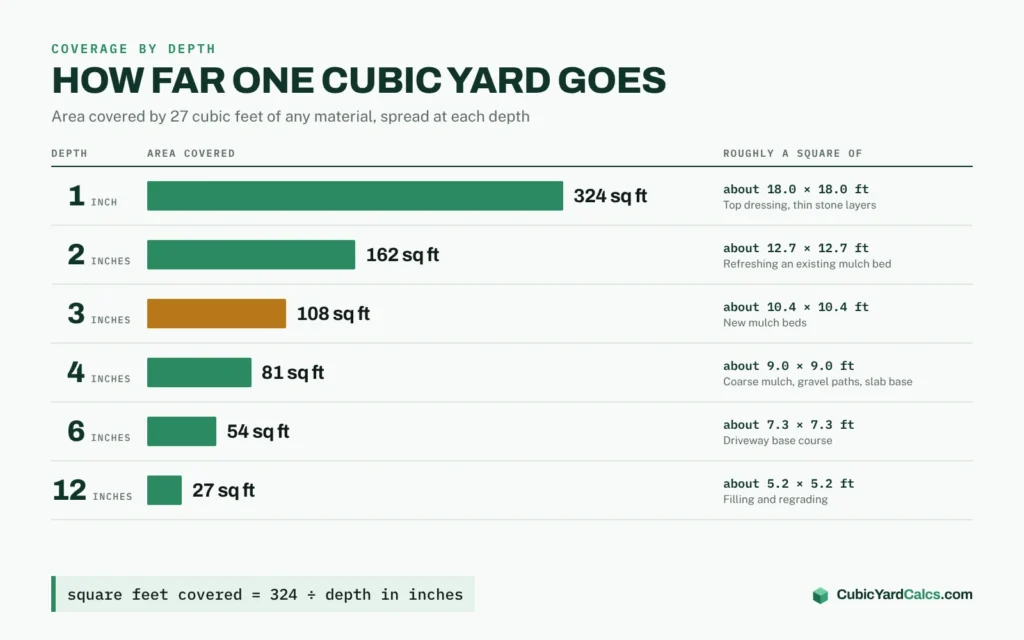
Coverage is volume divided by depth, so one table covers every material. A cubic yard holds 27 cubic feet, and 27 divided by a depth of one inch gives 324 square feet. Every other row is 324 divided by the depth in inches.
|
Depth |
One Cubic Yard Covers |
Where That Depth Shows Up |
|---|---|---|
|
1 inch |
324 sq ft |
Top dressing, thin stone layers |
|
2 inches |
162 sq ft |
Refreshing an existing mulch bed |
|
3 inches |
108 sq ft |
New mulch beds |
|
4 inches |
81 sq ft |
Coarse mulch, gravel paths, slab base |
|
6 inches |
54 sq ft |
Driveway base course |
|
12 inches |
27 sq ft |
Filling and regrading |
A handy rule sits inside that table: at three inches, one yard covers a little more than a ten-by-ten foot bed. If your depth is not on the list, the cubic yard calculator handles any value you enter.
How Deep Should The Material Go?
Depth changes the order more than the area does, so it is worth getting right rather than guessing.
For mulch, University of Minnesota Extension recommends 2 to 4 inches deep, balancing weed suppression with enough air movement into the soil. Iowa State University Extension narrows that by soil type: 3 to 4 inches of wood chips or shredded bark suits well-drained sites around trees and shrubs, while 2 to 3 inches works better on heavy soils, where a deep layer can waterlog the ground and block oxygen from reaching roots.
Two cautions appear in every extension guide worth reading.
- Never pile mulch against a trunk or stem: Penn State Extension recommends pulling mulch back 3 to 5 inches from young trees and 8 to 10 inches from mature ones, and keeping the depth at no more than 4 inches. Mulch heaped against bark holds moisture where it does damage and invites rodents.
- Stone goes on thinner than bark: University of Maryland Extension suggests a 1-inch layer of gravel, stone, or lava rock in planted areas, and 1 to 3 inches for bark mulches.
For structural work, such as gravel under pavers or a base course beneath a slab, follow the spec for your project or your local code rather than a general depth table. Those depths depend on the soil underneath and the load above.
Why Yards And Tons Are Not Interchangeable
Every material occupies the same space at the same volume. A cubic yard of mulch and a cubic yard of gravel are both 27 cubic feet. What changes, and changes a great deal, is the weight.
That matters in two situations. Some suppliers price stone and sand by the ton rather than by the yard, so you cannot compare quotes until you know how their product converts. And trucks have payload limits, so weight decides how many trips a delivery takes.
The honest answer on conversion is that it depends on the exact product and how wet it is. Moisture alone moves the weight of the same pile noticeably, and a screened topsoil, a clay-heavy fill, and a washed stone all land in different places.
That is why the calculator above shows weight as a range rather than a single figure. For the exact number, ask the supplier for the tons per cubic yard of the specific product you are ordering. They weigh loads every day and will have it. Bring your cubic yard figure and let them convert it to their own material.
Bags or Bulk: Which Should You Buy?
Bagged material is sold by the cubic foot and bulk by the cubic yard, so the comparison is only fair once both sit in the same unit.
bags per cubic yard = 27 ÷ bag size in cubic feet
Bag sizes vary by product and brand, and the size is printed on the front of every bag. Check it before you do the math, because two bags that look alike on a pallet can change the count substantially. A 2 cubic foot bag takes 13.5 bags to make a yard. A 1.5 cubic foot bag takes 18.
Bags win when the job is small, when material has to be carried through a gate or up steps, or when you want to store the leftovers. Bulk delivery wins on price per cubic foot as soon as the quantity climbs, and it saves an afternoon of splitting plastic. For most people, the two approaches cross over somewhere around the one-yard mark, though a delivery fee and your access to the site both move that line.
How Much Extra Should You Order?
Nobody spreads material perfectly, and most of it does not stay at the volume it arrived in.
- Settling and compaction: Soil and gravel consolidate once they are in place and walked or driven over. Ordering the exact calculated figure usually leaves you short.
- Spillage: Some material is lost off the edge of the wheelbarrow, and some stays behind in the corners of the pile.
- Uneven ground: Low spots swallow more than a flat measurement suggests.
A 5 to 10 percent margin covers most landscaping jobs, and a wider margin makes sense when the ground is rough, or the material compacts hard. The waste allowance is a setting in the tool so you can see the difference rather than running a second calculation by hand.
Then round up. A second delivery for half a yard costs far more than the half yard itself.
What This Cubic Yard Calculator Gives You
Most tools stop at the volume. This one carries the number through to the decision you actually have to make, which is what to tell the supplier.
|
Feature |
Why It Is There |
|---|---|
|
Rectangle, circle and triangle modes |
Real beds and pads are rarely square |
|
Add another area |
Totals several sections into one order |
|
Inch or foot depth toggle |
Depth is nearly always measured in inches |
|
Material selector |
Turns volume into an approximate weight range |
|
Waste allowance |
Applies your margin before rounding |
|
Bag count |
Answers the bags or bulk question on the spot |
|
Optional price per yard |
Gives a cost figure for the rounded order |
|
Copy for the supplier |
Produces a sentence you can send straight to the yard |
Common Mistakes Worth Avoiding
Most of these come up because the arithmetic is easy to start and easy to get subtly wrong. A cubic yard calculator removes the first two, and the rest are judgment calls you still have to make yourself.
- Leaving the depth in inches. Dividing by 27 with an inch value answers roughly twelve times too big.
- Ordering the exact figure. Without a waste margin, most jobs finish a little short.
- Assuming a ton and a yard are the same thing. They measure different properties, and the relationship changes with every material.
- Using one depth for the whole yard. A bed, a path, and a base course each need a different depth, so calculate them as separate areas.
- Forgetting access. The cheapest delivery is useless if the truck cannot reach the drop point.
Before You Call The Supplier
A short checklist saves a phone call in both directions.
|
Have Ready |
Why It Matters |
|---|---|
|
Your total in cubic yards |
It is the unit the yard works in |
|
The specific product name |
Density and price vary within the same material family |
|
Your rounded order quantity |
Suppliers work in set increments, so ask what theirs are |
|
Delivery access details |
Truck size, gate width, overhead wires, where the pile goes |
|
A question about the minimum order |
Many yards set one, and it is cheaper to know upfront |
Frequently Asked Questions
Twenty-seven. A cubic yard is a cube three feet on every side, so 3 by 3 by 3 gives 27 cubic feet.
Multiply the square footage by the depth in inches, then divide by 324. For a 240 square foot bed at 3 inches: 240 × 3 ÷ 324 = 2.22 cubic yards. A cubic yard calculator simply automates that division.
Three times the 27 cubic foot cube, so 81 cubic feet. Spread 3 inches deep, it covers about 324 square feet, roughly an 18 by 18 foot area.
Length in feet multiplied by width in feet multiplied by depth in feet, divided by 27.
It depends on depth. Divide 324 by the depth in inches: 162 square feet at 2 inches, 108 at 3 inches, 81 at 4 inches.
In most cases, yes. A 5 to 10 percent margin covers settling and spillage, and rounding up to your supplier’s next increment avoids a second delivery.
No. Volume is volume, whatever fills it. The material changes the weight, the price, and the depth you should be spreading it at, which is why the cubic yard calculator asks what you are buying.
Divide 27 by the bag size in cubic feet. That is 13.5 bags at 2 cubic feet each, or 18 bags at 1.5 cubic feet.
How We Check These Numbers
Every formula behind this cubic yard calculator is arithmetic you can repeat, and every depth recommendation comes from a named university extension service rather than from another calculator site. The weight ranges in the tool come from published conversion factors, and each one is listed with its source under the calculator. Where a figure depends on the specific product, this page says so instead of publishing a single number that might not match what lands on your driveway.