
How Big Is a Cubic Yard? Size, Dimensions and Visual Examples
Picture a box three feet long, three feet wide, and three feet tall, with a yardstick laid along every edge. That box is one cubic yard. Fill it with soil, gravel, or mulch, and you have the “yard” that landscape suppliers, concrete plants, and dumpster companies talk about.
So how big is a cubic yard in numbers? It is 27 cubic feet, 46,656 cubic inches, about 202 US gallons, and about 0.765 cubic meters.
Below you will see what a cubic yard looks like on the ground, how to mark one out with string, and how big 2, 3, 5 and 10 cubic yards get. If you already have measurements and need a volume, the cubic yard calculator on our homepage does the math.
What Is a Cubic Yard?
A cubic yard is a unit of volume: the space inside a cube that measures one yard on each side. A yard is exactly 3 feet, or 36 inches, and US law has fixed it at exactly 0.9144 meters since 1959 (NIST Handbook 44). Volume multiplies three lengths, so one cubic yard equals 3 × 3 × 3 = 27 cubic feet.
Bulk material is sold by the space it fills, not by length or flat area. That is why the answer to how big a cubic yard is stays the same whatever goes inside it: a yard of mulch and a yard of gravel take up the same room but weigh very different amounts.
Dimensions of a Cubic Yard in Feet, Inches and Meters
The dimensions of a cubic yard are 3 feet by 3 feet by 3 feet, which is the short answer to how big a cubic yard is. Here is the same cube written in every unit you are likely to need:
| Unit | Each Edge | Volume |
|---|---|---|
| Yards | 1 yd | 1 cubic yard |
| Feet | 3 ft | 27 cubic feet |
| Inches | 36 in | 46,656 cubic inches |
| Meters | 0.9144 m | 0.7646 cubic meters |
| Centimeters | 91.44 cm | 764,555 cubic cm (764.6 liters) |
Every row describes the same box. If you are asking how big a cubic yard is with only an inch tape in hand, the answer is 36 × 36 × 36 inches.
How Much Is a Cubic Yard?
People who ask how much is a cubic yard usually mean quantity rather than price. One cubic yard holds:
- 27 cubic feet, or 13.5 bags of the 2 cubic foot size (the cubic feet to cubic yards converter handles other bag sizes)
- about 202 US gallons, because a US gallon is 231 cubic inches and 46,656 ÷ 231 = 201.97
- about 764.6 liters, which is 0.7646 cubic meters
How big is a cubic yard never changes, but price depends on the material and your local supplier, so get a current quote for that part.
What Does a Cubic Yard Look Like?
Seeing the answer to how big a cubic yard is works better than reading it. As a pile, it looks smaller than people expect, and spread thin, it covers more ground than they expect. A delivered load also rarely keeps a neat cube shape; it slumps into a mound that is wider and lower than 3 feet. The clearest way to see one is to build an outline.
Mark Out a Cubic Yard with String and Stakes
- Push four stakes into the ground at the corners of a 3-by-3-foot square. Measure both diagonals: on a true square, each one is about 4 feet 3 inches.
- Tie string around the stakes 3 feet above the ground, or stand a yardstick at each corner.
- Step back and walk around it. The space inside the strings is one cubic yard.
- Now re-stake a 9-by-9-foot square and picture it filled 4 inches deep. That flat patch holds the same 27 cubic feet.
Ten minutes with string turns how big a cubic yard is from a number into something you can walk around.
One Cubic Yard, Three Shapes
So how big is a cubic yard once it leaves the box? That depends on how it lies. These three shapes all hold exactly one cubic yard:
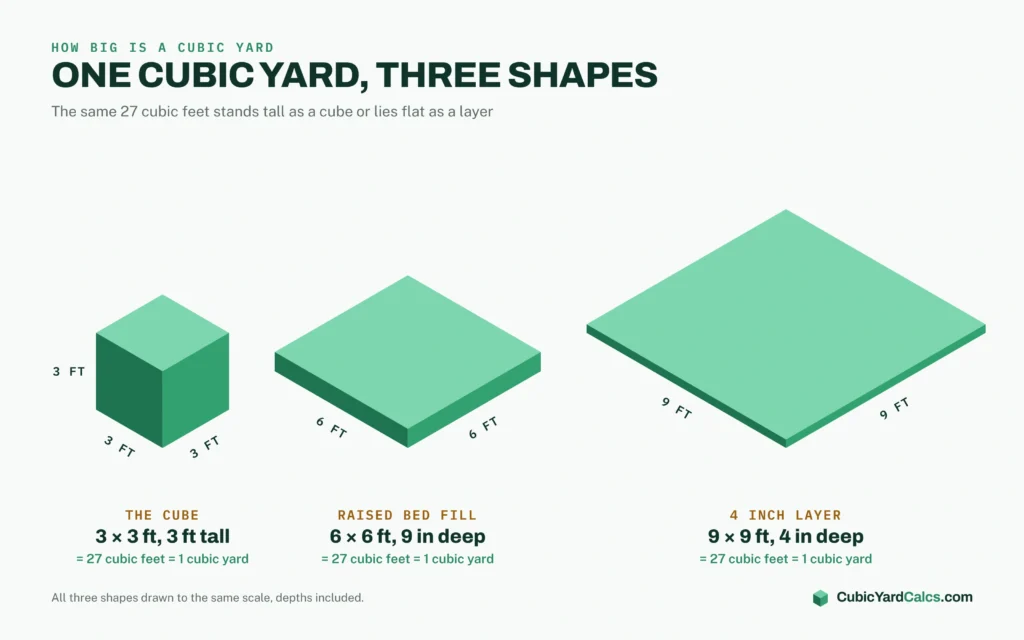
- 3 × 3 foot footprint, 3 feet tall: the textbook cube.
- 6 × 6 foot footprint, 9 inches deep: a deep fill for a small raised bed.
- 9 × 9 foot footprint, 4 inches deep: a 4-inch layer of gravel or topsoil over an 81 square foot patch.
Footprint in square feet × depth in feet comes to 27 every time. To work this out for your own area, use the square feet to cubic yards guide.
Test Any Size Comparison with One Formula
Online, a cubic yard gets compared to all kinds of household objects. Rather than trusting a comparison, measure the object and test it. It is the fastest way to settle how big a cubic yard is next to anything in your garage:
cubic yards = length × width × height in inches ÷ 46,656
- Washing Machine: a washer measuring 27 by 28 by 38 inches (example dimensions, so measure yours) is 28,728 ÷ 46,656 = 0.62 cubic yards, well short of a full yard.
- Pickup Truck Bed: the Landscape Recycling Center measures a full-size bed at 8 feet long, 5.33 feet wide, and 1.5 feet high. That is 8 × 5.33 × 1.5 ÷ 27 = 2.37 cubic yards, which the center rounds to 2 yards loaded level. Check your payload before you fill it: 2 yards of 3/4 inch gravel can weigh about 2.6 to 3.4 tons.
- Wheelbarrow: divide 27 by the capacity stamped on the tub in cubic feet. A 6 cubic foot wheelbarrow takes 4.5 level loads to move one yard.
- 33 Gallon Trash Bags: 202 ÷ 33 = about 6 full bags per cubic yard.
How Big Is 3 Cubic Yards? Plus 2, 5 and 10
Once you know how big a cubic yard is, larger orders are multiplication. Multiply 27 cubic feet by the number of yards, then picture the result as a cube or as a spread layer. How big is 3 cubic yards? It is 81 cubic feet: a cube about 4 feet 4 inches on each side, or a 4-inch layer over 243 square feet, roughly a 15.6 by 15.6 foot square.
- 2 Cubic Yards: 54 cubic feet. A cube about 3 feet 9 inches per side, or 162 square feet at 4 inches deep.
- 5 Cubic Yards: 135 cubic feet. A cube about 5 feet 2 inches per side, or 405 square feet at 4 inches deep.
- 10 Cubic Yards: 270 cubic feet. A cube about 6 feet 6 inches per side, or 810 square feet at 4 inches deep.
Doubling the yards doesn’t double the cube’s height. Ten yards stands only a little more than twice as tall as one, because the extra volume spreads in all three directions.
Size is only half of the order. Three yards of mulch and three yards of gravel fill the same space but need very different trucks; the tons per yard ranges show by how much.
Cubic Yard vs Square Yard vs Linear Yard
Part of knowing how big a cubic yard is is knowing what it is not. All three of these show up on quotes, and they measure different things:
- Linear yard: a length of 3 feet: Used for fabric, edging, and fencing.
- Square yard: an area of 3 × 3 = 9 square feet: Used for carpet and some turf and site plans.
- Cubic yard: a volume of 27 cubic feet: Used for soil, gravel, mulch, sand, and concrete.
One square yard covered 1 foot deep is only 9 cubic feet, a third of a cubic yard. To reach a full cubic yard, you need that square yard filled 3 feet deep, or a 4-inch layer over 9 square yards.
Cubic Yard vs Cubic Meter
Outside the US, the question of how big a cubic yard is usually comes up against the cubic meter, which is the bigger unit. One cubic yard is 0.7646 cubic meters, and one cubic meter is about 1.308 cubic yards. When a product sheet lists a volume in cubic meters, multiply it by 1.308 to get cubic yards.
Go Measure a Cubic Yard Yourself
On paper, the answer to how big a cubic yard is is short: 3 by 3 by 3 feet, 27 cubic feet, about 202 gallons. It sticks far better once you have stood next to one, so before your next order, grab four stakes, a ball of string, and a tape measure.
Mark the 3-foot square first, then mark the flat shape your project really needs and compare the two. Once you have the real length, width, and depth, enter them in the cubic yard calculator and order a number you can picture.
Quick Answers About Cubic Yard Size
Yes. How big a cubic yard is does not depend on the material: both fill 27 cubic feet. The weight is what changes: mulch runs about 0.12 to 0.24 tons per cubic yard, while 3/4 inch gravel runs about 1.28 to 1.69 tons.
Measure the bed length, width, and side height in feet, multiply them, and divide by 27. The Landscape Recycling Center puts a full-size bed at about 2 cubic yards loaded level and a short bed at up to 1.5. Heavy material such as gravel can reach the payload limit first.
A cubic yard is about three-quarters of a cubic meter: 0.7646 cubic meters. Each edge is 0.9144 meters, compared to 1 meter for a cubic meter.