
Cubic Yards to Tons Converter and Tons per Yard Chart
Cubic yards to tons is the conversion people get wrong most often, because it is not a simple unit swap. A cubic yard measures space and a ton measures weight, and how many tons fill that space depends entirely on what is in it. A cubic yard of 3/4 inch gravel weighs roughly 1.3 to 1.7 tons; a cubic yard of wood chips weighs about a tenth of that.
- POUNDS
- 0
- METRIC TONNES
- 0
- CUBIC YARDS PER TON
- 0
On delivery tickets, cubic yards are often shortened to CY, so CY to tons is the same job. Here is the short version of cubic yards to tons for common bulk materials:
| Material | Tons Per Cubic Yard | Cubic Yards Per Ton |
|---|---|---|
| Mulch, wood chips | 0.12 to 0.24 | 4.2 to 8.3 |
| Topsoil | 1.02 to 1.69 | 0.59 to 0.98 |
| Fill dirt (clay) | 1.15 to 1.49 | 0.67 to 0.87 |
| Gravel, 3/4 inch | 1.28 to 1.69 | 0.59 to 0.78 |
| Crushed stone | 1.35 | 0.74 |
| Sand | 1.38 to 1.65 | 0.61 to 0.72 |
| Concrete, poured | 1.82 to 2.16 | 0.46 to 0.55 |
| Asphalt | 1.35 | 0.74 |
Tons here are US short tons of 2,000 pounds. Every cubic yard-to-ton range is sourced in the density section further down.
How to Convert Cubic Yards to Tons
Multiply the volume by the weight of one cubic yard of the material. That weight is called bulk density, and it is the only number in the conversion that changes from one job to the next.
The Cubic Yards to Tons Formula
tons = cubic yards × tons per cubic yard
If the supplier gives density in pounds per cubic yard, divide by 2,000 at the end:
tons = cubic yards × pounds per cubic yard ÷ 2,000
Some spec sheets list pounds per cubic foot instead. Multiply that by 27 first, since a cubic yard holds 27 cubic feet, and you have pounds per cubic yard.
Worked Example: 6 Cubic Yards of Gravel
A 6-yard load of 3/4 inch gravel at 1.28 to 1.69 tons per cubic yard:
6 × 1.28 = 7.7 tons 6 × 1.69 = 10.1 tons
The low figure is the stone dry, and the high figure is the stone wet. A spread of more than 2 tons on one load is the reason converting cubic yards to tons should always end in a range, and the reason a supplier’s own number beats any chart.
How to Convert Tons to Cubic Yards
To convert tons to cubic yards, divide instead of multiplying:
cubic yards = tons ÷ tons per cubic yard
How Many Cubic Yards in a Ton?
Divide one ton by the density, and you have the cubic yards in a ton. For 3/4 inch gravel, that is 1 ÷ 1.69 to 1 ÷ 1.28, or about 0.59 to 0.78 cubic yards, which answers how many yards in a ton for most stone. Mulch is the opposite case: one ton fills roughly 4 to 8 cubic yards. The right-hand column of the table above uses the same division for every material.
The cubic yards-to-tons converter below works in both directions, so it doubles as a yards-to-tons calculator and a tons-to-cubic-yards one, and it accepts your supplier’s density when you have it.
Which Ton? Short Tons, Metric Tonnes, and Long Tons
In the United States, a ton on a delivery ticket almost always means the short ton. The three units are fixed by definition, as listed in NIST Handbook 44:
| Unit | Pounds | Kilograms |
|---|---|---|
| Short ton (US ton) | 2,000 | 907.18 |
| Metric tonne | 2,204.62 | 1,000 |
| Long ton (UK ton) | 2,240 | 1,016.05 |
To turn short tons into metric tonnes, multiply by 0.907. A cubic yard of 3/4 inch gravel at 1.28 to 1.69 short tons is about 1.16 to 1.53 metric tonnes, and the converter shows both figures side by side. Check which ton a quote uses before you compare cubic yards to tons across suppliers.
Tons per Cubic Yard by Material - Where the Numbers Come From
Every range used for cubic yards to tons on this page comes from a published source, converted to US short tons per cubic yard:
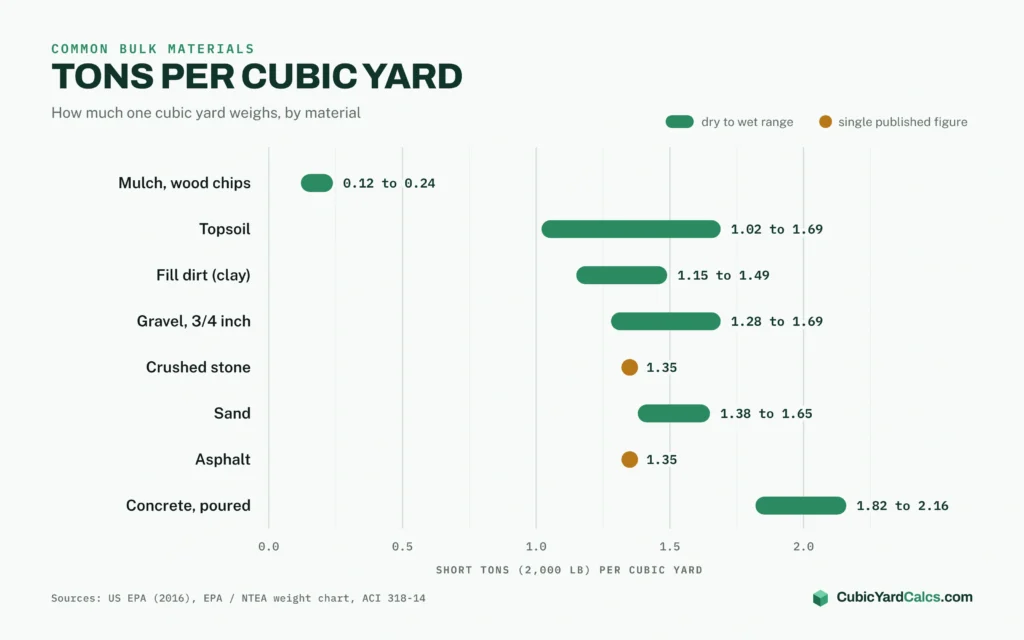
| Material | Tons Per Cubic Yard | Pounds Per Cubic Yard | Source |
|---|---|---|---|
| Mulch, wood chips | 0.12 to 0.24 | 243 to 473 | US EPA, Volume-to-Weight Conversion Factors (2016), dry to green |
| Topsoil | 1.02 to 1.69 | 2,040 to 3,380 | Material weight chart sourced from EPA and NTEA, loose to wet |
| Fill dirt (clay) | 1.15 to 1.49 | 2,300 to 2,980 | Same chart, dry to wet |
| Gravel, 3/4 inch | 1.28 to 1.69 | 2,560 to 3,380 | Same chart, dry to wet |
| Crushed stone | 1.35 | 2,700 | Same chart, average |
| Sand | 1.38 to 1.65 | 2,760 to 3,300 | Same chart, dry to wet |
| Concrete, poured | 1.82 to 2.16 | 3,645 to 4,320 | ACI 318-14, normal-weight concrete 135 to 160 lb per cubic foot |
| Asphalt | 1.35 | 2,700 | Material weight chart sourced from EPA and NTEA |
Soil has a useful cross-check. The USDA Natural Resources Conservation Service gives ideal bulk densities below 1.60 g/cm³ for sandy soils, 1.40 for silty soils, and 1.10 for clayey soils. Converted, that is roughly 1.35, 1.18, and 0.93 tons per cubic yard of dry soil in the ground, in the same territory as the dry end of the topsoil and fill ranges above.
Why One Chart Cannot Cover Every Supplier
Look up tons per cubic yard on a few calculator sites and the answers rarely agree. Published charts for topsoil alone run from about 1.0 to 1.35 tons per yard, often with no source attached. The spread is real rather than a mistake, and it comes from three things:
- Moisture: Water fills the gaps between particles and adds weight without adding volume, which is why the gravel and sand ranges above run from dry to wet.
- Compaction: Material settles in the truck bed and again on site, so a loose yard in the loader bucket and a compacted yard in the ground do not weigh the same.
- Gradation and source: Two quarries can both sell “3/4 inch gravel” from different rock with a different share of fines, so the same name can weigh differently.
Even official tables come with context. The EPA’s 2016 Volume-to-Weight Conversion Factors list dirt and sand at 929 pounds per cubic yard, about a third of what delivered sand weighs, because that figure describes loose construction and demolition debris for waste planning, not screened material from a supply yard. Using it to convert cubic yards to tons for an order would badly understate the weight.
So treat every cubic yards to tons chart, ours included, as a planning range. When an order is priced or trucked by weight, ask the supplier for the tons per cubic yard of the exact product and enter it in the converter’s custom field.
Priced per Ton or per Yard? Comparing Two Quotes
Some suppliers sell stone and sand by the ton while others quote the same products by the yard. To compare the two, run a cubic yards-to-tons conversion so both quotes sit in the same unit. The prices below are example figures to show the math, not market rates.
| Detail | Quote A: priced per ton | Quote B: priced per yard |
|---|---|---|
| Price | $40 per ton | $60 per cubic yard |
| Order | 8 cubic yards of 3/4 inch gravel | 8 cubic yards of 3/4 inch gravel |
| Weight at 1.28 to 1.69 tons per yard | 10.2 to 13.5 tons | Not needed |
| Total | $410 to $541 | $480 |
Quote B is a fixed $480. Quote A lands anywhere from $410 to $541 depending on how heavy the stone is on delivery day. The break-even point is the density where both match: $60 ÷ $40 = 1.5 tons per cubic yard. If the supplier’s figure for that product is under 1.5, the per ton quote is cheaper; above 1.5, the per yard quote wins.
Cubic Feet to Tons
If your volume is in cubic feet, divide by 27 to get cubic yards, then multiply by the tons per cubic yard. 54 cubic feet of sand is 2 cubic yards, or about 2.8 to 3.3 tons. Our page on converting cubic feet to cubic yards has a 1 to 100 chart for that first step.
Cubic yards to tons comes down to one multiplication and one honest number: the weight of a yard of your material. Plan with the ranges on this page, order with the supplier’s figure, and if you are starting from length, width, and depth, work out the cubic yards first.
The Bottom Line on Cubic Yards to Tons
Cubic yards to tons comes down to one multiplication and one honest number: the weight of a yard of your material. Keep these four points in mind before you order:
- The math is simple: Tons equal cubic yards multiplied by tons per cubic yard, and going from tons to cubic yards uses the same figure as a divisor.
- Most bulk materials sit in a narrow band: Sand, gravel, and soil weigh roughly 1 to 1.7 short tons per cubic yard, poured concrete more, and mulch only a fraction of that.
- Plan with a range, not one number: Moisture, compaction, and the quarry all move the weight of the same yard.
- Order with the supplier's figure: Ask for the tons per cubic yard of the exact product, and check whether the quote uses short tons or metric tonnes.
If you are starting from length, width, and depth, work out the cubic yards first, then come back here to put a weight on them.
Cubic Yards to Tons (Common Questions)
It depends on the material. A cubic yard of sand, gravel, or topsoil usually weighs about 1 to 1.7 short tons, poured concrete about 1.8 to 2.2, and mulch about 0.12 to 0.24. For any other product, use the supplier’s figure in the cubic yards-to-tons converter.
Multiply the short ton figure by 0.907. For 3/4 inch gravel, that gives about 1.16 to 1.53 metric tonnes per cubic yard.
Divide 1 by the tonnes per cubic yard. For gravel at 1.16 to 1.53 tonnes per yard, one tonne fills about 0.65 to 0.86 cubic yards.
Find the cubic yards in a ton, then multiply by 27. For 3/4 inch gravel, 0.59 to 0.78 cubic yards per ton works out to about 16 to 21 cubic feet.
No. A yard is volume and a ton is weight. They only come close for materials that weigh about one ton per cubic yard, such as some dry soils, and even then moisture moves the number.